

A checklist tells you what to verify before deploying Microsoft 365 Copilot. A framework tells you whether you can ship. The difference matters: dozens of organizations have run thorough checklists, found dozens of issues, and still deployed Copilot anyway because no one had translated the findings into a single defensible score.
The four-pillar AI readiness framework below is the methodology MSPs, Microsoft consultancies and enterprise IT teams converge on. It is grounded in the Microsoft Cloud Adoption Framework, weighted by real-world impact, and produces a CAF Score that boards and DSI committees can act on.
What is an AI Readiness Framework?
An AI readiness framework is a structured methodology that evaluates whether an organization's environment can safely host an AI assistant. It does three things a checklist alone cannot:
- Weights pillars by business impact. Not all gaps are equal — an oversharing problem is several orders of magnitude more dangerous than a missing sensitivity label.
- Provides a maturity scale. A 1.0–5.0 score per pillar, aggregated into a global CAF Score, replaces "27 issues found" with one defensible number.
- Defines decision thresholds. 3.5 unlocks pilot deployment, 4.5 unlocks production deployment, anything below 3.5 triggers a remediation gate.
Without these three layers, a checklist remains advisory. With them, the framework becomes a board-level decision tool — and a defensible one for ISO 27001, SOC 2 and EU AI Act audits.
Pillar 1: Data Exposure 40%
What it measures
Data Exposure quantifies how much of your tenant's content is reachable beyond its intended audience. It captures broad sharing links, accidentally public Teams channels, OneDrive content shared with external addresses, and SharePoint sites with broken inheritance.
Why it carries 40% of the score: Microsoft 365 Copilot inherits permissions verbatim. A single overshared file produces immediate, machine-speed exposure when an end-user asks the right natural-language question. No other pillar generates risk of this magnitude.
Typical failure patterns
- "Anyone in the organization" links created in 2018–2022 for one-off meetings, never revoked.
- Default sharing scope set to "Anyone with the link" at the tenant level.
- Broken inheritance on legacy SharePoint libraries containing financial or HR data.
- "Everyone except external users" group used as a convenient catch-all on critical sites.
- Public Teams channels containing sensitive draft documents or M&A discussions.
Average industry score
Across the assessments Cloudiway has run on real Microsoft 365 tenants, the average Data Exposure score is 3.1 / 5.0 — the lowest of the four pillars. Concentric AI's parallel research shows organizations average 802,000 overshared files.
Pillar 2: Access Governance 25%
What it measures
Access Governance evaluates the strength of identity controls — MFA coverage, Conditional Access posture, guest lifecycle, role assignment hygiene, and Privileged Identity Management adoption.
Why it carries 25% of the score: If an attacker compromises a user identity, Copilot becomes their query engine over your sensitive content. Identity is the first defensive control before anything else matters.
Typical failure patterns
- Admin accounts without MFA, particularly in subsidiaries or recently acquired entities.
- Dormant guest accounts (no sign-in in 90+ days) still holding access to internal SharePoint sites.
- Service principals with Files.ReadWrite.All consented to non-essential third-party apps.
- No Conditional Access baseline blocking legacy auth or requiring compliant devices for sensitive apps.
- Standing global admin assignments instead of PIM-eligible activation.
Average industry score
Average across measured tenants: 3.5 / 5.0. Notable improvement since Microsoft started enforcing MFA on admin portal access in 2024.
Pillar 3: Data Protection 25%
What it measures
Data Protection captures the strength of Microsoft Purview deployment — sensitivity labels published and applied, DLP policies enforced, retention/records management aligned with legal requirements, audit logging in place, and Information Barriers deployed where regulated.
Why it carries 25% of the score: Sensitivity labels are how you tell Copilot "handle this differently". Without them, Copilot has no signal to differentiate confidential from public content. DLP policies prevent post-generation leakage when users export Copilot answers.
Typical failure patterns
- Sensitivity labels published but never applied — fewer than 5% of documents carry a label.
- No auto-labeling policies for high-volume PII or financial content.
- DLP policies in audit-only mode indefinitely, never moving to enforce.
- Missing Information Barriers in regulated industries (front-office vs research, legal Chinese walls).
- Audit log search not enabled or not ingested into a SIEM.
Average industry score
Average across measured tenants: 2.9 / 5.0 — the second-lowest pillar. Sensitivity labeling adoption remains the #1 blocker for high CAF scores.
Pillar 4: AI Governance 10%
What it measures
AI Governance evaluates the policy, training and operational readiness around AI itself — published AI usage policies, employee training, prompt-injection awareness, defined acceptable-use scope, EU AI Act compliance, and a governance committee with clear ownership.
Why it carries 10% of the score: AI Governance has high regulatory weight (EU AI Act, GDPR Art. 35) but lower direct technical exposure. It is the policy layer on top of the technical pillars.
Typical failure patterns
- No published AI usage policy or one that mentions ChatGPT but not Copilot.
- No DPIA (Data Protection Impact Assessment) on file before Copilot deployment.
- No prompt-injection awareness training for employees handling external content.
- EU AI Act classification missing for high-risk use cases (HR, legal, financial decisions).
- No designated AI governance owner across IT, Legal, Compliance and HR.
Average industry score
Average: 3.2 / 5.0. Improving rapidly under EU AI Act pressure since 2025.
How to Compute the CAF Score
Each pillar is scored from 1.0 to 5.0 based on the proportion of checks passed within it. The pillar scores are then weighted into a single global CAF Score:
| Pillar | Weight | Example score | Weighted contribution |
|---|---|---|---|
| Data Exposure | 40% | 3.0 | 1.20 |
| Access Governance | 25% | 4.0 | 1.00 |
| Data Protection | 25% | 3.5 | 0.875 |
| AI Governance | 10% | 3.0 | 0.30 |
| Global CAF Score | 3.375 / 5.0 | ||
In the example above, the tenant scores 3.375, just below the 3.5 pilot threshold. The framework would recommend remediating Data Exposure first (lowest score × highest weight = biggest leverage) before any Copilot rollout.
Benchmarks Across Industries
Across hundreds of real Microsoft 365 tenants assessed in 2025–2026, the average global CAF Score sits at 3.4 / 5.0 — just under the pilot threshold. Notable variation by industry:
| Industry | Average CAF Score | Weakest pillar |
|---|---|---|
| Banking & Insurance | 4.0 | AI Governance (regulatory pressure helps the technical pillars) |
| Pharmaceutical & Healthcare | 3.7 | Data Exposure (research collaboration patterns) |
| Public sector / Government | 3.5 | Data Protection (Purview adoption uneven) |
| Manufacturing | 3.2 | Data Exposure (broad sharing in legacy SharePoint farms) |
| Education | 2.9 | Access Governance (lots of guest accounts, weak MFA) |
| Mid-market SMB | 2.8 | All four pillars (limited governance maturity) |
The takeaway: most organizations are not Copilot-ready by default, regardless of size or industry. The framework sets the bar; the work is in the remediation.
Framework vs. Assessment Platform: Why Both Matter
The framework defines what to score. An AI readiness assessment platform is what runs the framework against your actual tenant.
Manually applying the four-pillar framework to a single Microsoft 365 tenant takes 8 to 10 working days of senior consultant time — PowerShell scripts, multiple admin portal cross-checks, CSV consolidation, manual interpretation. For an MSP serving multiple clients, that math does not work.
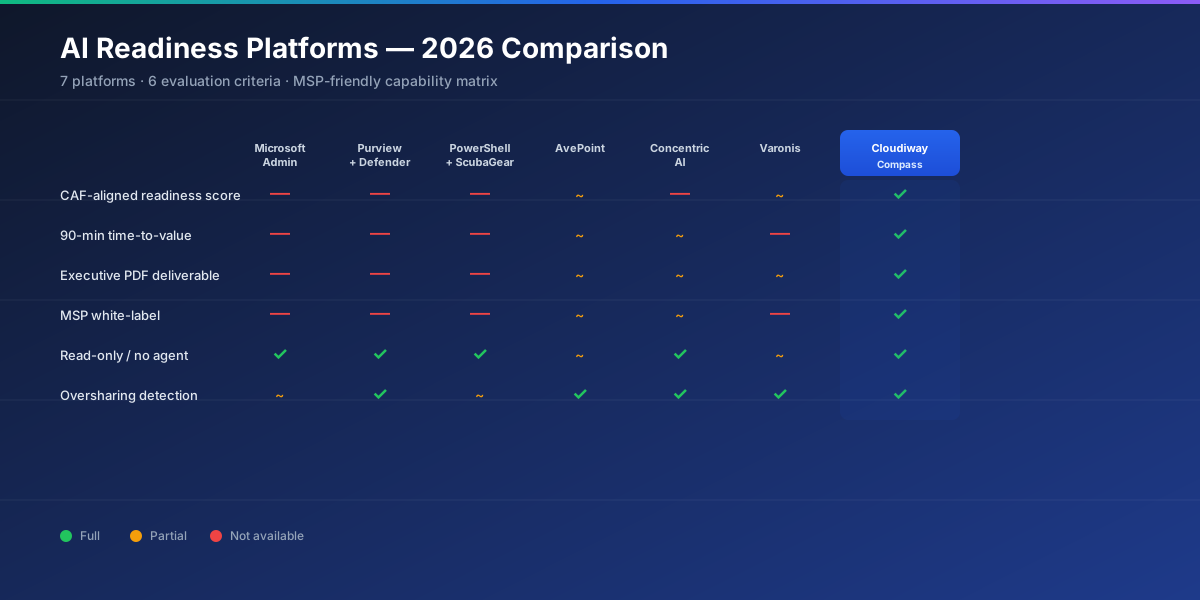
The Cloudiway AI Readiness Assessment automates the entire framework. A read-only OAuth connection scans 100+ checks across the four pillars in roughly 90 minutes, computes the weighted CAF Score, and produces an executive PDF, technical Excel and interactive remediation dashboard. The framework remains the source of truth; the platform is the engine that runs it.
Get your CAF Score in 90 minutes — not 10 days
OAuth read-only connection · 100+ checks across the four pillars · objective CAF Score · executive PDF and 30-day remediation plan.
Start a Free AI Readiness Assessment →Frequently asked questions about the AI readiness framework
What is an AI readiness framework?
An AI readiness framework is a structured methodology used to evaluate whether an organization's IT environment can safely host an AI assistant such as Microsoft 365 Copilot. The most widely adopted framework is built on four weighted pillars derived from the Microsoft Cloud Adoption Framework (CAF): Data Exposure (40%), Access Governance (25%), Data Protection (25%) and AI Governance (10%). Each pillar is scored from 1.0 to 5.0 and the weighted average produces a single CAF Score that drives the deploy / remediate / block decision.
How is the AI readiness framework different from a checklist?
A checklist tells you what to verify; a framework tells you how to score and prioritize. The AI readiness framework adds three things on top of a checklist: (1) weighting of pillars by business impact, (2) a 1.0–5.0 maturity scale that produces an objective and reproducible score, and (3) decision thresholds (3.5 = pilot-ready, 4.5 = production-ready) that translate the score into action. Most enterprises run the checklist and then map the results into the framework for board-level reporting.
Why is Data Exposure weighted at 40% of the AI readiness score?
Data Exposure receives the highest weighting because Microsoft 365 Copilot inherits permissions verbatim. A single overshared confidential document — for example a payroll file shared via 'Anyone in the organization' link — can be surfaced to any employee on the very first natural-language query. No other pillar produces immediate, machine-speed exposure of that magnitude. Concentric AI's research shows organizations average 802,000 overshared files; addressing this risk is the single biggest lever on AI readiness.
What CAF Score is required to deploy Microsoft 365 Copilot safely?
Industry guidance from MSPs and large integrators (Cloudiway, CHEOPS Technology, MB Solutions and others) converges on the following thresholds: a CAF Score of 3.5 or higher allows deployment to a controlled pilot group while remaining gaps are remediated; 4.5 or higher is the recommended threshold for production-wide rollout. Scores below 3.5 indicate critical exposures across at least one pillar and Copilot deployment should be paused until remediation is complete.
Is the AI readiness framework specific to Microsoft 365 Copilot?
The four-pillar framework is generic enough to apply to any enterprise AI assistant that operates over corporate data — Microsoft 365 Copilot, Google Gemini for Workspace, ChatGPT Enterprise with custom GPTs, Claude for Work, and similar offerings. The pillar names and weightings remain the same; only the underlying checks change to match each platform's permission model and integration surface.
How does Cloudiway implement the AI readiness framework?
The Cloudiway AI Readiness Assessment automates the four-pillar framework end-to-end: it runs 100+ checks across SharePoint, OneDrive, Teams, Exchange, Entra ID and Microsoft Purview, scores each check against the corresponding pillar, computes the weighted CAF Score, and produces an executive PDF, technical Excel and interactive remediation UI. The whole process runs in roughly 90 minutes from a read-only OAuth connection.